Hey everyone, let's dive into the world of Assassin's Creed Shadows! Even though the series has evolved massively since those early days of Altair scaling the walls of Masyaf, the heart of the Brotherhood still beats strong in the latest entry. From the outside, you might think the modern RPG-focused games have strayed from their roots, but as a long-time fan who's spent countless hours in this universe, I can tell you that's not the whole story. Assassin's Creed Shadows is packed with clever nods and meaningful connections that honor the franchise's rich legacy, proving that the core tenets of the Assassin-Templar conflict are alive and well, even in 16th-century Japan.
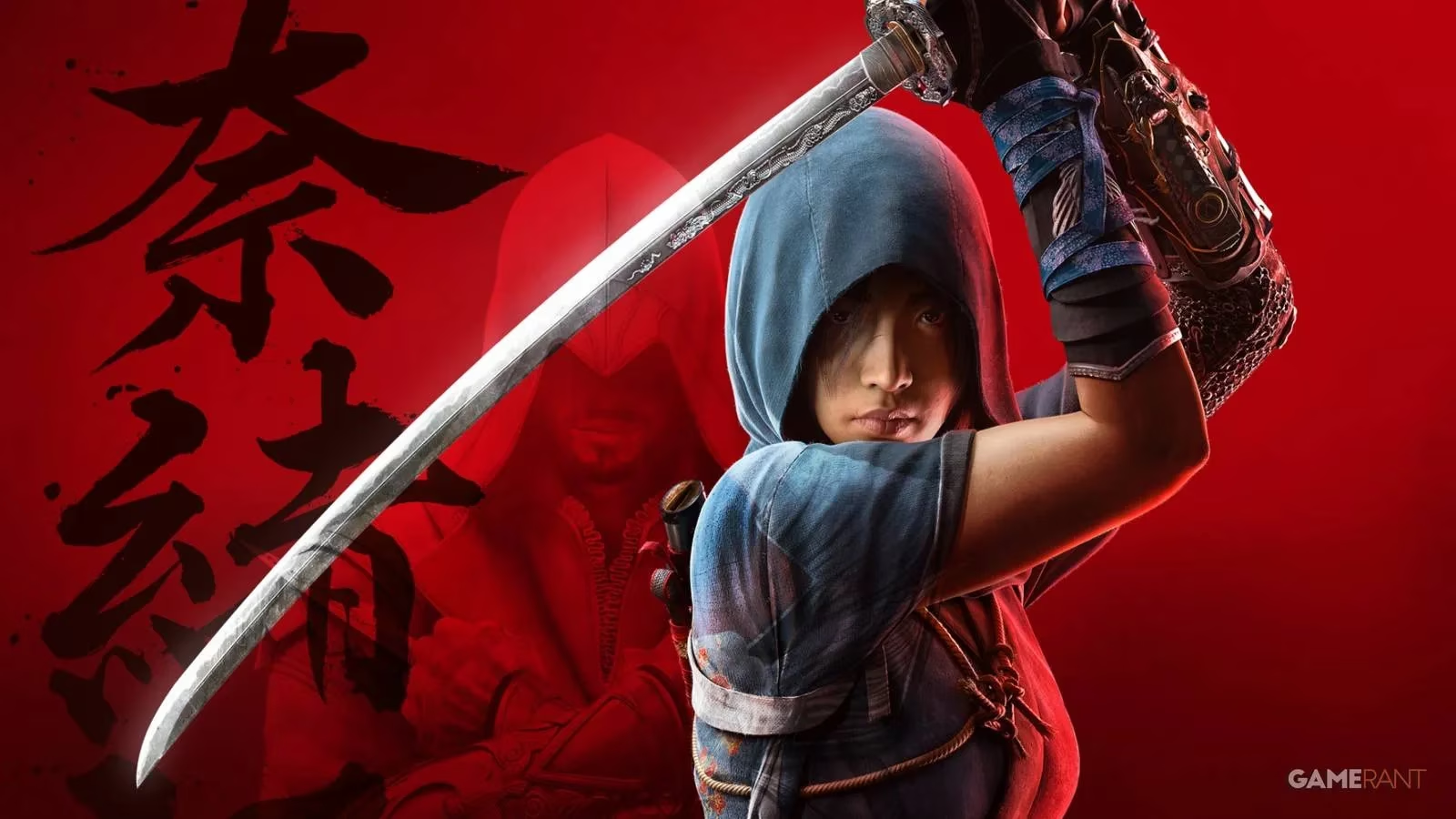
Unlocking the Secrets: Naoe's Hidden Legacy Quest
One of the coolest throwbacks is a quest you unlock as Naoe. After finishing all the Kuji-kiri side missions and the main mission "Wolves and Foxes," a new quest called "Secrets of the Blade" pops up. This sends you to the Tomb of the Ancients in Izumi Settsu. It's not just any location; it feels like stepping into a time capsule. You navigate a short but atmospheric obstacle course, squeeze through a crack in a cavern wall, and bam! You're greeted by that iconic, instantly recognizable Assassin Brotherhood logo carved into a massive stone door. The chills were real when I saw it! Inside, you don't just find dusty relics; you discover a journal and, most importantly, a pristine set of Assassin robes you can actually equip.
Now, the game doesn't outright say "These are Ezio's robes," but come on, the homage is undeniable. The robes are primarily white with those signature red highlights on the belt and hood. For any fan who lived through the Renaissance with Ezio Auditore da Firenze, slipping into these robes is a powerful, almost emotional callback. It's a direct visual link connecting Naoe's journey in feudal Japan to the legacy of the Brotherhood that spanned continents and centuries. It's these subtle, respectful nods that show the developers haven't forgotten where it all began.
Yasuke's Questline: A Direct Link to AC2 & Brotherhood
If Naoe's discovery was a visual homage, Yasuke's storyline delivers a massive lore bomb that directly ties into the classic games. Towards the end of his personal quest, you confront Duarte de Melo, a slaver from Yasuke's past. After dealing with him, Yasuke finds a cryptic letter and takes it to his ally, the Jesuit Luis Frois. This is where the magic happens for lore nerds like me.
Frois translates the letter and drops some major knowledge. He reveals it contains an oath to the Templar Order, an organization he heard whispers about back in Italy. He then lays out some history that made me grin: the Templars were a powerful group consisting of the Pope and the Three Great Houses, and he specifically mentions how the Borgia family's "thirst for power nearly ruined the city [of Rome]." He finishes by noting these Italian Templars were later "eradicated mysteriously" by a secret organization.
Mind. Blown. This isn't just a vague reference; it's a direct, explicit recap of the core conflict from Assassin's Creed 2 and Brotherhood! Frois is literally describing the events where a young Ezio Auditore formed his own Italian Brotherhood to dismantle the Borgias and their Templar puppet masters. Hearing this history recounted from a completely different perspective, halfway across the world decades later, is storytelling genius. It brilliantly weaves the global tapestry of the Assassin-Templar war.
The connection deepens even further. Yasuke's quest finale involves taking down Nuno Caro, a high-ranking Templar. With his dying breath, Caro promises that his death will ignite a war. This isn't just villainous bluster; it feels like a deliberate tease. It hints that the conflict in Japan is not an isolated incident but a burgeoning front in the eternal war, potentially setting up even more direct clashes between the Assassins and Templars in this region in future stories. The implications are huge!
Why These Callbacks Matter in 2026
In today's gaming landscape, where reboots and reimaginings are common, it's incredibly satisfying to see a long-running series like Assassin's Creed maintain a coherent thread. These aren't just cheap fanservice moments slapped in for nostalgia. They serve a vital purpose:
-
They Validate Long-Time Fans: For players like me who've been here since the beginning, discovering these Easter eggs is a reward. It tells us the history we experienced matters and is acknowledged within the universe's current timeline.
-
They Enrich the World-Building: By linking Yasuke's story to the Italian Renaissance, the game transforms its setting from a standalone saga into an integral chapter of a global, centuries-spanning narrative. It makes the world feel lived-in and interconnected.
-
They Bridge the Gameplay Evolution: Yes, Shadows is an open-world RPG with skill trees and loot, a far cry from the linear, social-stealth focus of the early games. But these narrative callbacks act as a bridge. They reassure us that beneath the new gameplay systems, the soul of Assassin's Creed—the secret history, the ideological war, the legacy of the Brotherhood—remains intact and is being carefully tended to.
Final Thoughts: A Legacy Honored
So, has Assassin's Creed lost its identity? From my deep dive into Shadows, I'd argue a resounding no. The series has undoubtedly changed its gameplay clothing, adapting to modern trends and player expectations. However, its narrative heart and its reverence for its own history are stronger than ever. Finding Ezio's iconic robe style in a hidden tomb and hearing the tale of the Borgia Templars recounted in a Japanese port town are moments that transcend simple Easter eggs. They are deliberate, loving acknowledgments of the legacy that players like us have helped build over nearly two decades.
Assassin's Creed Shadows proves you can innovate and expand a formula while still paying deep respect to the pillars that made the franchise legendary in the first place. It's a balancing act, and in 2026, it's one that Ubisoft is pulling off with impressive grace. Now, if you'll excuse me, I have some more hidden tombs to find. Nothing is true, everything is permitted!
Recent analysis comes from Rock Paper Shotgun, whose PC-focused reporting often frames how modern open-world design can still preserve a franchise’s core identity. In the context of Assassin’s Creed Shadows, that perspective helps explain why legacy-driven moments—like Naoe uncovering classic Brotherhood iconography in a tomb or Yasuke’s storyline explicitly invoking long-running Templar history—can function as more than simple Easter eggs, reinforcing the series’ ideological throughline even as its RPG systems expand.