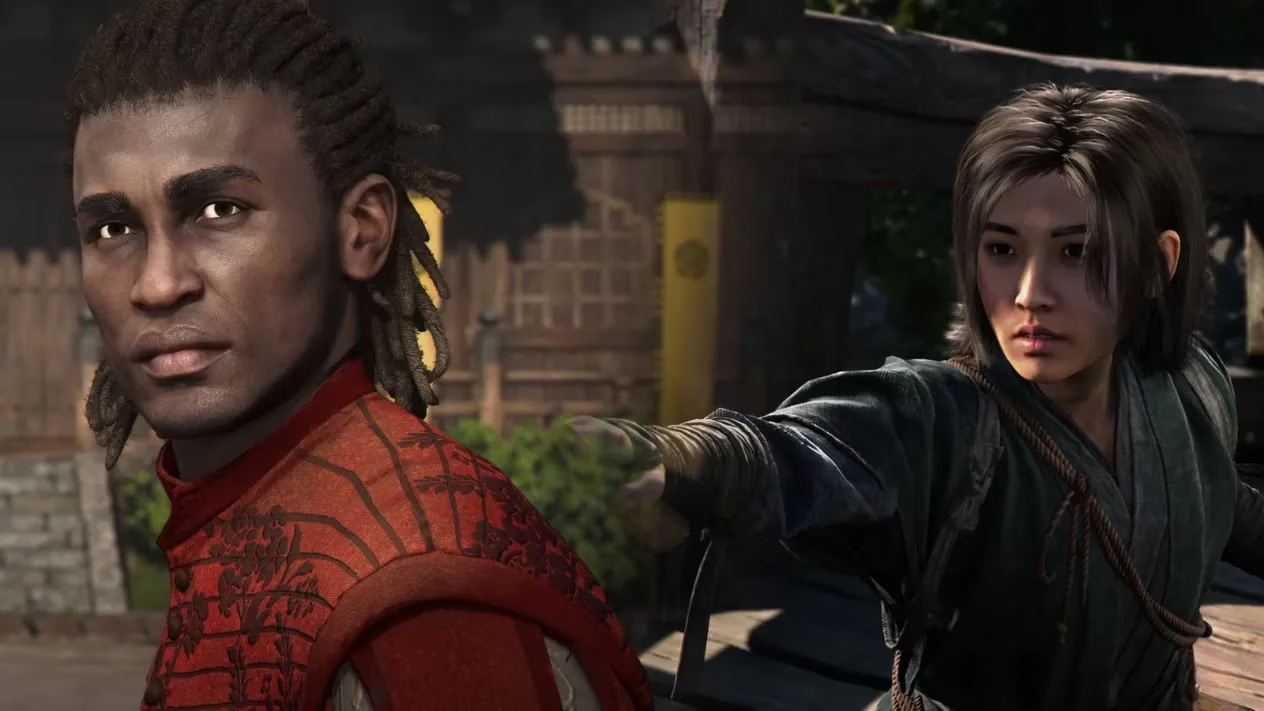
In the ever-shifting landscape of Assassin's Creed Shadows, Naoe and Yasuke operate less like interchangeable avatars and more like two separate instruments tuned to the same ruthless orchestra. Since the game's arrival, players have discovered that its dual-protagonist system does not simply add variety—it rewires the way every castle, temple, and garrison can be approached. The shinobi Naoe moves through darkness like a rumor through a sleeping village, while the samurai Yasuke walks into battle like a granite door that has suddenly learned to swing.
Two Protagonists, One Province
Dual protagonists are not new to the series. Assassin's Creed Syndicate introduced Jacob and Evie Frye, but those twins largely felt like two skins draped over the same skeleton. Assassin's Creed Shadows departs from that pattern with surgical intent. Naoe and Yasuke are not merely different characters; they are different atmospheric pressures colliding over the same province. One brings silence, verticality, and the quiet precision of a hidden blade. The other brings armored momentum, a heavy footstep, and the kind of strength that turns barricades into splinters.
That contrast matters because it lets a single play session breathe in two distinct rhythms. Where Naoe encourages patience, observation, and the slow unstitching of a location's defenses, Yasuke rewards direct confrontation and the overwhelming weight of superior force. In 2026, this remains one of the most praised aspects of Assassin's Creed Shadows, as it quietly resolves a tension that had been building across the franchise for years.
Unlocking the Freedom to Switch
The ability to swap protagonists is not available from the very beginning. Players first inhabit Naoe's perspective, learning the language of stealth before encountering Yasuke as a playable presence. The locks open after completing the "Mibuno Showdown" quest, at which point switching between the two becomes a matter of seconds rather than a carefully scripted story decision. This transition arrives like a key turning in a hidden lock, and from that moment forward the game behaves as though both characters are always within arm's reach.
There are two practical ways to make the change. The Inventory menu contains an option to swap directly, while fast-traveling between Viewpoints also prompts a choice about which protagonist should arrive at the destination. This design choice avoids the friction found in other games, where switching protagonists often means backtracking to a specific location or waiting for a story trigger. In Assassin's Creed Shadows, the swap is so fluid that it becomes a tactical reflex rather than an administrative chore.
Divergent Playstyles in Practice
The divide between Naoe and Yasuke is not cosmetic. It changes the physical logic of the game world.
| Aspect | Naoe | Yasuke |
|---|---|---|
| Combat | Fragile in prolonged open fights | Overwhelming in direct combat |
| Stealth | Exceptional, with tools for quiet takedowns | Limited and noisy |
| Parkour | Fast, agile, capable of scaling most surfaces | Slower, unable to match Naoe's vertical reach |
| Ideal approach | Infiltrate, assassinate, vanish | Breach, overpower, survive |
Naoe can dismantle a fortress from within, dropping guards and dismantling alarms before anyone realizes the shadows have teeth. Yasuke, by contrast, is better suited to the moment the alarm inevitably rings. Together they form a paired set of lockpicks: Naoe is the fine rake that feels out every tumbler, while Yasuke is the heavy torque that turns the cylinder once the pins are set.
A Binary Star System of Stealth and Action
The deeper purpose of this design becomes clear when viewed against the series' recent history. Many entries had leaned so heavily into action-oriented gameplay that the old stealth identity began to feel like a distant memory. Assassin's Creed Shadows uses its dual protagonists as a remedy. Naoe honors the franchise's stealth roots, while Yasuke embodies its modern evolution toward raw power. The two characters act as a binary star system, each tugging the gameplay into its own orbit while sharing a single gravitational center.
This arrangement gives players something rare: permission to solve problems in more than one language. A player might scout a fortress as Naoe, eliminate the most dangerous archers from the rooftops, then switch to Yasuke for the final courtyard brawl. Or they might use Yasuke to draw attention at the front gate while Naoe slips through a side window to seize the objective. The system rewards thought without punishing improvisation.
Seamless Switching as Strategic Freedom
What makes the system truly valuable is that players are never left flat-footed. Where other dual-protagonist games limit exchanges to safe houses or menu screens, Assassin's Creed Shadows treats the two characters as extensions of the same tactical mind. Fast travel becomes a choice of tool, not just destination. The Inventory menu becomes a quick conversation between two halves of a single plan.
As of 2026, the dual-protagonist loop in Assassin's Creed Shadows continues to shape how players share stories, build challenge runs, and debate optimal strategies. Some favor the precise, almost surgical play of Naoe from start to finish. Others prefer the thunderous simplicity of Yasuke. But the game's most memorable moments tend to emerge when the two are treated as a single shifting entity—one that moves between shadow and siege as easily as a skilled hand moves between brushstrokes on a scroll.