Assassin's Creed made its debut in 2007 with three pillars that defined the experience: stealth, action, and parkour. Those systems were bundled into a history-inspired open world and remained the backbone of the franchise for roughly a decade. Every sequel kept them at the center even as new mechanics arrived. By 2026, fans looking back at Assassin's Creed Shadows can still see those pillars, but the balance has shifted once again.
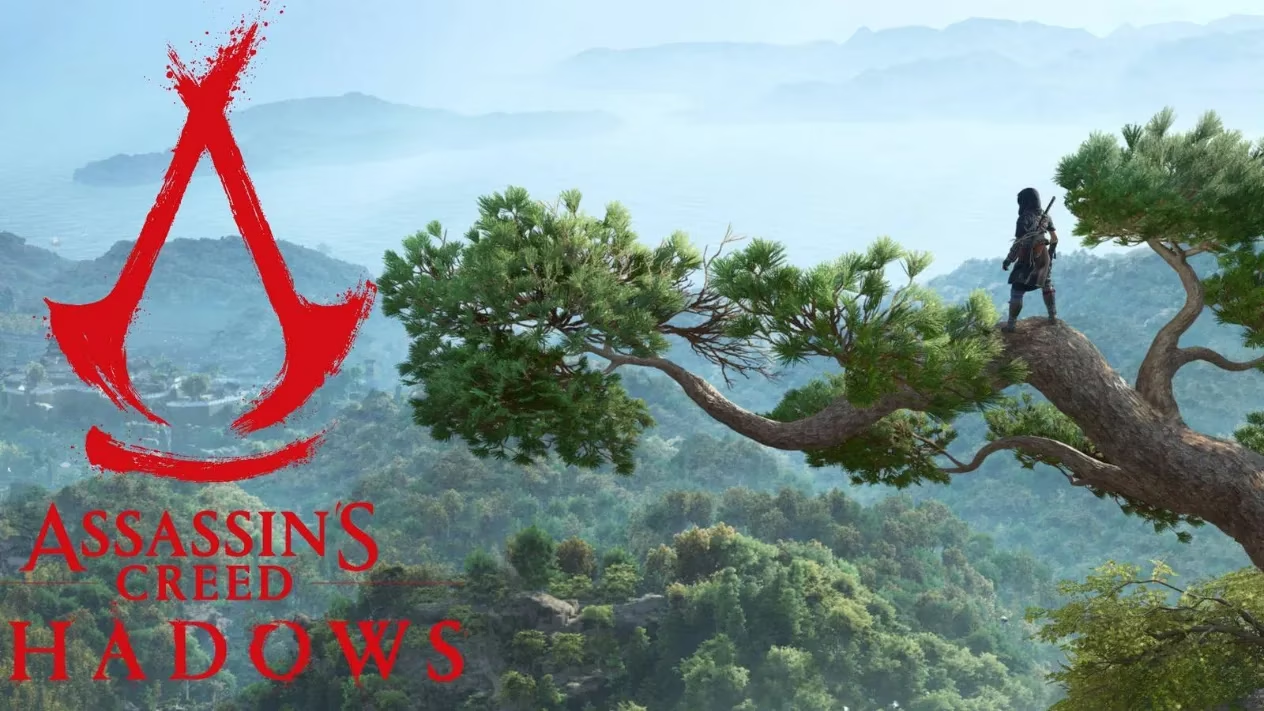
The turn toward RPG mechanics began with Assassin's Creed Origins in 2017. That title introduced a dramatic formula change, pushing action and character progression to the front while stealth and parkour moved into supporting roles. The RPG features have since grown into a core pillar of their own. As that pillar has expanded, the older pillars have been left further below. Assassin's Creed Shadows is the fourth main entry in this RPG arc, and though stealth receives more attention than it has in years, parkour still follows the same lower-priority pattern.
In Shadows, the parkour systems fit the game's Feudal Japan setting very well. Players control Naoe, a shinobi, and can climb walls, leap across rooftops, and ascend or descend tall castle structures with relative ease. Her animations are fast, fluid, and packed with distinctive flairs. Graceful midair flips and powerful leaps help sell her training. The visual language makes even simple traversal feel stylish.
For the first time since Assassin's Creed Syndicate in 2015, a grappling hook returns. Naoe can use it to quickly scale buildings, swing from certain structures, and cross gaps using nearby foliage. The tool adds both practicality and personality to the movement system. In many situations, it feels great to use, offering a satisfying mix of speed and style. Players can chain rooftop routes and vertical climbs in ways that suit a shinobi fantasy.
Despite those strengths, the overall parkour experience in Shadows is generally good rather than exceptional. Object collision issues occasionally break the flow, and some movements can feel awkward when the environment does not cooperate. Still, traversal gets the job done, and it frequently does it well. For most players, the movement is smooth enough to enjoy without demanding deep mechanical mastery.
A bigger change becomes clear when comparing Shadows to the earliest entries. Movement in Shadows is more streamlined than ever. Players mostly hold one of two buttons to ascend or descend whatever structure they are on. That approach lowers the barrier to entry and keeps the action moving, but it also removes much of the player control that defined classic Assassin's Creed parkour. The days of reliably pulling off a wall-eject are long gone. In Shadows, players have very little say over how they actually scale buildings or move through the environment. The system does the work for them, prioritizing accessibility over expression.
The environmental side of parkour has also been reduced. Assassin's Creed Mirage included poles and other interactive objects that added variety to traversal. Those interactions are rare in Shadows. Without them, the world can feel less like a network of movement puzzles and more like a series of surfaces to hold a button against. The grappling hook helps mask this loss, but it does not fully replace the missing depth.
A quick comparison of the series' design priorities shows the shift:
| Era | Core Focus | Parkour Role |
|---|---|---|
| 2007\u20132015 | Stealth, action, parkour | A full pillar with skilled control |
| 2017\u20132023 | RPG progression and action | Supporting system, increasingly streamlined |
| Assassin's Creed Shadows | RPG expansion and stealth | Fluid but simplified, with a grappling hook |
The table highlights a clear evolution. The early games treated parkour as a skill with consequences. Players had to read their surroundings, time inputs, and use techniques like wall-ejects to move efficiently. Shadows replaces much of that with two-button navigation and occasional grappling hook swings. That is not necessarily a failure. Modern players often want faster, friction-free movement, and the change matches the broader action-RPG direction. Yet it leaves a part of the series' identity behind.
For fans who fell in love with the original trilogy or the tighter movement of the Ezio era, Shadows is likely to feel light on mechanical complexity. 📉 For newcomers, the simplified system is easy to learn and rarely frustrating. 📈 The result is a parkour feature that is both better and worse depending on what a player wants from Assassin's Creed.
From a 2026 perspective, Assassin's Creed Shadows stands as a polished open-world adventure with strong movement animations and a useful new tool in the grappling hook. However, parkour is no longer the equal partner it once was. It remains a visible part of the franchise, but it now serves the RPG loop rather than standing beside it. Until the series decides to restore deeper traversal mechanics, the classic parkour pillar will continue to fade into history.