I still remember the first time I switched between Evie and Jacob Frye on the cobblestone streets of Victorian London. It was 2015, and Assassin’s Creed Syndicate felt refreshingly bold. Fast-forward to 2026, and I’m reflecting on how Ubisoft has taken that original dual protagonist spark and turned it into a roaring flame with Assassin’s Creed Shadows. The studio has always loved experimenting with character dynamics, from the co-op flirtations of Unity to the RPG personas of Odyssey and Valhalla. But nothing compares to the narrative and gameplay contrast between Naoe and Yasuke. Shadows didn’t just revisit the Syndicate formula—it overhauled it, deepened it, and delivered the most compelling tag-team journey the series has seen.
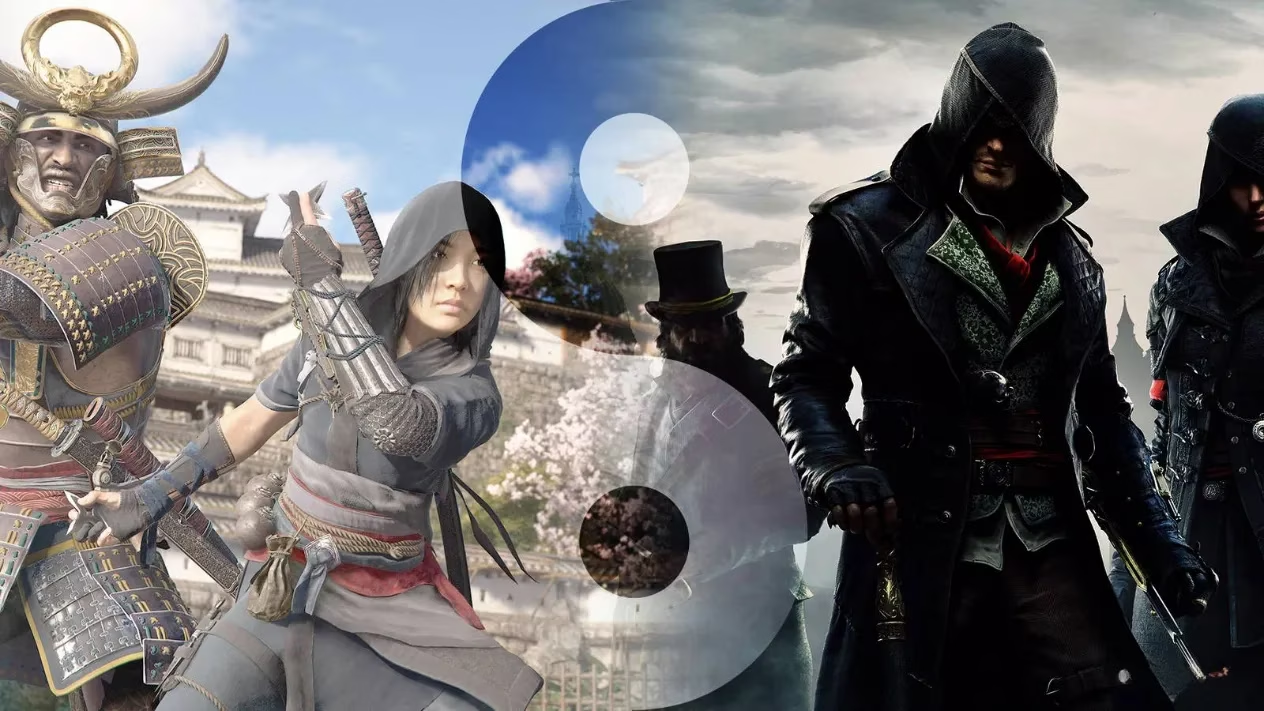
Assassin’s Creed Syndicate was a pioneer, no doubt. For the first time in the franchise, players freely alternated between two fully voiced, personality-packed siblings. Evie embodied the classical assassin’s creed—her moves wreathed in silence, shadows, and precise hidden blade strikes. Jacob, on the other hand, was a brawler who relished chaotic fistfights and gang takeovers. Yet for all their surface differences, the twins shared a common toolbox of parkour, stealth takedowns, and Victorian gadgets. Their true divergence lay in temperament: Evie’s obsessive hunt for the Piece of Eden versus Jacob’s rowdy crusade to reclaim London borough by borough. They argued, they rolled their eyes, but ultimately they were a united front, siblings whose bickering never truly jeopardized their bond. Playing as them felt like controlling two sides of the same coin—entertaining, but not revolutionary.
Then came Assassin’s Creed Shadows, and I realized how restrained Syndicate had been. Set in 16th-century Japan, Shadows introduces Naoe, a shinobi assassin with a personal vendetta, and Yasuke, the legendary African samurai serving Oda Nobunaga. When I first took control of these two, the disparity was staggering. Naoe is lithe, fragile, and reliant on the shadows; a single misplaced step in open combat can spell her end. Yasuke plows through enemies like a force of nature, shrugging off arrows and smashing armor with brutal efficiency. Their skill trees don’t just bend the archetypes—they shatter them. Naoe can crawl through gaps, vanish in smoke, and execute parkour lines that Yasuke can only dream of. Yasuke, conversely, can kick down barred doors and wield heavy kanabo clubs that send guards flying. Playing them consecutively feels like swapping between a whisper and a war drum, and that rhythm is intoxicating.
Where Shadows truly elevates the concept is in its storytelling. Unlike the Frye twins, Naoe and Yasuke begin as ideological enemies. In the early hours, I watched Yasuke cut down a Japanese Brotherhood member under Nobunaga’s orders—an act that shattered Naoe’s world. Their eventual meeting is charged with grief, mistrust, and simmering rage. There’s no cheery sibling banter here; every tentative alliance feels earned through blood-soaked missions and reluctant campfire conversations. I remember a moment where Naoe finally accepted Yasuke’s help to track a Shinbakufu target, and the quiet tension between them spoke louder than any Syndicate cutscene. The dual protagonist system becomes a vehicle for layered character development, not just gameplay variety. By the time they stand back-to-back against a common foe, the emotional payoff dwarfs anything the Frye twins ever delivered.
The structural freedom also feels more mature. In Syndicate, certain missions were locked to one twin, forcing you down a predetermined path. Shadows embraces organic choice. I spent entire evenings sneaking through castles as Naoe, only to switch to Yasuke when I craved the thunder of a direct assault. The open world doesn’t punish you for sticking to a favorite, yet the narrative gently nudges you to experience both perspectives. Side activities, from flute-playing meditations to sumo wrestling matches, are tailored to each protagonist’s identity, making the act of switching feel less like a gameplay toggle and more like stepping into a different life.
What excites me most in 2026 is how Shadows has set a new benchmark. Rumors already swirl about the next Assassin’s Creed title experimenting with an even larger protagonist ensemble. Could we see a trio of distinct characters, or perhaps a dynamic where one character’s choices permanently alter the other’s world? The success of Naoe and Yasuke proves that players crave contrast—not just cosmetic differences, but genuine mechanical and narrative dissonance that ultimately resolves into harmony. Syndicate planted the seed, but Shadows harvested a rich, complex crop. As a veteran of the hidden blade, I can’t wait to see how future installments sharpen this blade even further.
Assassin’s Creed Shadows reminds me why I fell in love with this franchise: the boldness to reinvent its core structures while staying true to the eternal conflict between creed and power. The dual protagonist system has become a canvas for storytelling innovation, and 2026’s hindsight makes Syndicate’s early steps look charmingly quaint. If Ubisoft continues listening to what made Naoe and Yasuke unforgettable—courageous design, emotional intimacy, and unapologetic player agency—the next chapter will be nothing short of legendary.