I never expected a video game to replace a textbook, but the moment I stepped into Assassin’s Creed Shadows’ Discovery Tour in early 2026, my entire understanding of the Sengoku period shifted. The air was thick with cherry blossom petals spiraling across the sunlit courtyard of Osaka Castle. No guards stormed toward me, no time limit blinked in the corner—just the distant call of a crow and an invitation to walk through a museum where every exhibit breathed. After years of wishing for a quiet way to absorb Feudal Japan away from the chaos of main campaign assassinations and power struggles, Ubisoft finally delivered a mode that feels like a living scroll painting.
The Discovery Tour series has always been a quiet treasure hidden inside the Assassin’s Creed franchise. It started with 2018’s Origins, transforming Ptolemaic Egypt into a pacifist sandbox where players could wander without weapons and instead listen to researchers detail the intricacies of mummification or the engineering of the Pyramids. Odyssey followed suit, draping the robes of Classical Greece around a similar educational framework. But it was Valhalla’s iteration that planted the seeds for what Shadows would eventually perfect. In 2020’s Viking-era tour, I could pick from a handful of distinct characters—a Norse trader, an Anglo-Saxon monk, a traveling seer—each offering a questline that taught me history through doing, not just reading. I still remember laying planks for a longship while the narrator explained how overlapping clinker-built hulls revolutionized open-sea travel. The mode even let me tread across the rainbow bridge into Asgard, a mythological layer that blended belief systems with tangible heritage. That design language—letting history inhabit the hands, not just the eyes—became the blueprint.
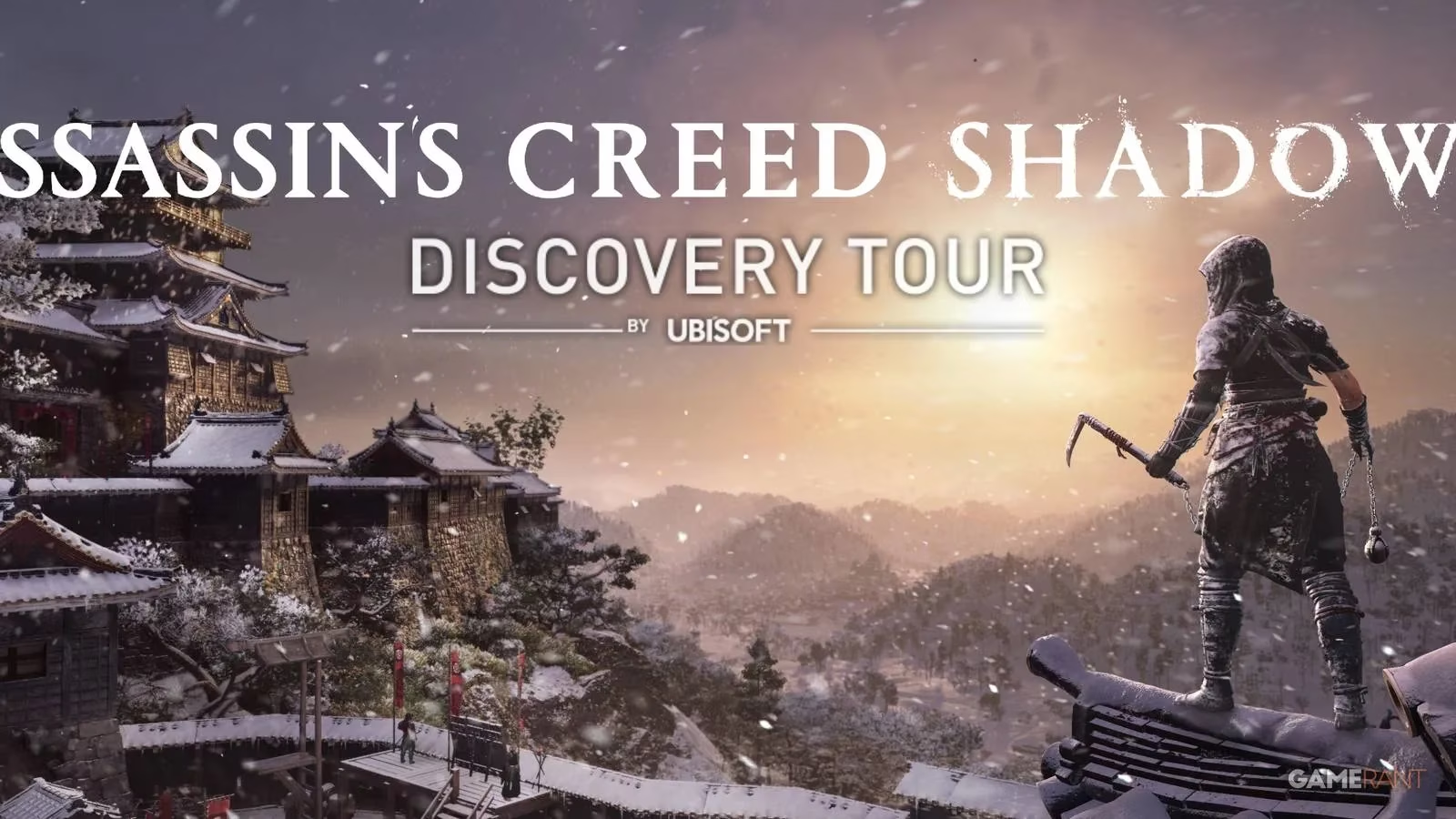
Fast-forward to 2026, and Shadows’ Discovery Tour expands that blueprint into something profoundly intimate. The default story mode of Shadows was already a whirlwind: Oda Nobunaga’s fall, the rise of Tokugawa Ieyasu, the shifting loyalties of clans like the Oda, Takeda, and Uesugi thrown at the player amid a backdrop of civil war. Even as someone who devoured samurai films, I often lost the thread amid the barrage of daimyos, generals, and political upheaval. The Discovery Tour severs that thread cleanly and lays out each strand like a silk tapestry under soft museum lighting. Right away I’m offered a roster of avatars far richer than Valhalla’s. The first I choose is a Portuguese merchant newly arrived in Hirado, and through his eyes I learn about Nanban trade, the introduction of firearms, and how a foreigner might perceive the rigid class structure of 16th-century Japan. Another run lets me inhabit a miko shrine maiden, triggering a guided pilgrimage that connects sacred mountains to kami worship, complete with narrated stops at vermillion torii gates I had only glimpsed during frantic rooftop chases in the base game.
What makes this tour so unforgettable is the sheer variety of landmarks and life-sized dioramas. Osaka Castle isn’t just a static fortress—it becomes a multi-room exhibit where I can interact with everything from storage cellars for rice (koku) payments to the intricate lock mechanisms of a keep’s hidden doorways. A floating lantern ceremony on Lake Biwa morphs into a spoken-word history of Azuchi Castle and Oda Nobunaga’s revolutionary castle-town design. When I step onto the grounds of the Hanno-ji Incident, the world freezes into a tranquil reenactment, and historian commentary unpacks the betrayal that altered Japan’s unification path without any requirement to fire a single arrow. The guided tour even weaves in figures like Yasuke, the African samurai, and lets me polish a katana in his company while listening to excerpts from real Jesuit records. For students and lifelong learners, this transforms a dusty lesson plan into a fully immersive field trip. I watch my niece, who had never touched an Assassin’s Creed game, guide a Buddhist monk avatar through a tea ceremony and emerge explaining the meaning of wabi-sabi with gleaming eyes. That’s the quiet magic Discovery Tour achieves: it erases the boundary between entertainment and education so casually that you don’t realize you’ve memorized the names of one hundred provinces until you’re already using them in conversation.
Underneath all the curated tours, the mode still respects free exploration. On a rainy afternoon I spend an hour simply walking the entire Tokaido road between Edo and Kyoto, pausing at post stations to read interactive plaques about rest-stop economies and the 53 Stations of the Tokaido woodblock prints later made famous by Hiroshige. No combat encounter breaks the spell, no animus distortion flickers at the edges of my screen—just the sound of rain on my virtual straw hat and the feeling that I’m a time traveler who forgot the return ticket and doesn’t mind one bit. Small quests, like crafting washi paper or helping a village prepare for a matsuri festival, work like Valhalla’s longship-building segments but feel anchored in a culture that deeply values ritual. I walk away from my time in the tour not with a level-up ding but with something weightier: a mental map of Sengoku Japan that the game’s frantic stabbing and sprinting never gave me.
When I finally exit the Discovery Tour and return to the menu screen, I notice the soundtrack still echoing in my head—a shakuhachi flute note that outlasts the controller vibrations. Assassin’s Creed Shadows already delivered a striking historical sandbox in 2024, but this dedicated educational layer is the calm after the storm, a necessary exhale. It’s the kind of mode that makes me want to donate my console to a high school world history class just to see what happens. Ubisoft took the turmoil of the Azuchi-Momoyama period and handed us a peaceful key, proving once more that virtual heritage experiences aren’t just tech demos—they’re doorways into empathy, intricately lit and carved from cedar, waiting for us to slide them open.