In the twilight of feudal Japan, the shadows are learning to dance. Assassin's Creed Shadows, the latest chapter in the storied franchise, has always held the art of parkour close to its heart, a silent partner to the blade and the bow. Yet, for all its focus on stealth and traversal, its acrobatics have often felt earthbound, yearning for the dizzying heights scaled by the masters of old. Now, as 2026 dawns, the winds of change are whispering through the bamboo groves and castle keeps. A series of promised updates, charted on a year-one roadmap, are not merely adding features; they are weaving new threads of freedom into the very fabric of movement. These are not revolutions, but rather, the careful restoration of a forgotten language—a lexicon of leaps, ejects, and climbs that promises to let Naoe speak with her feet once more.
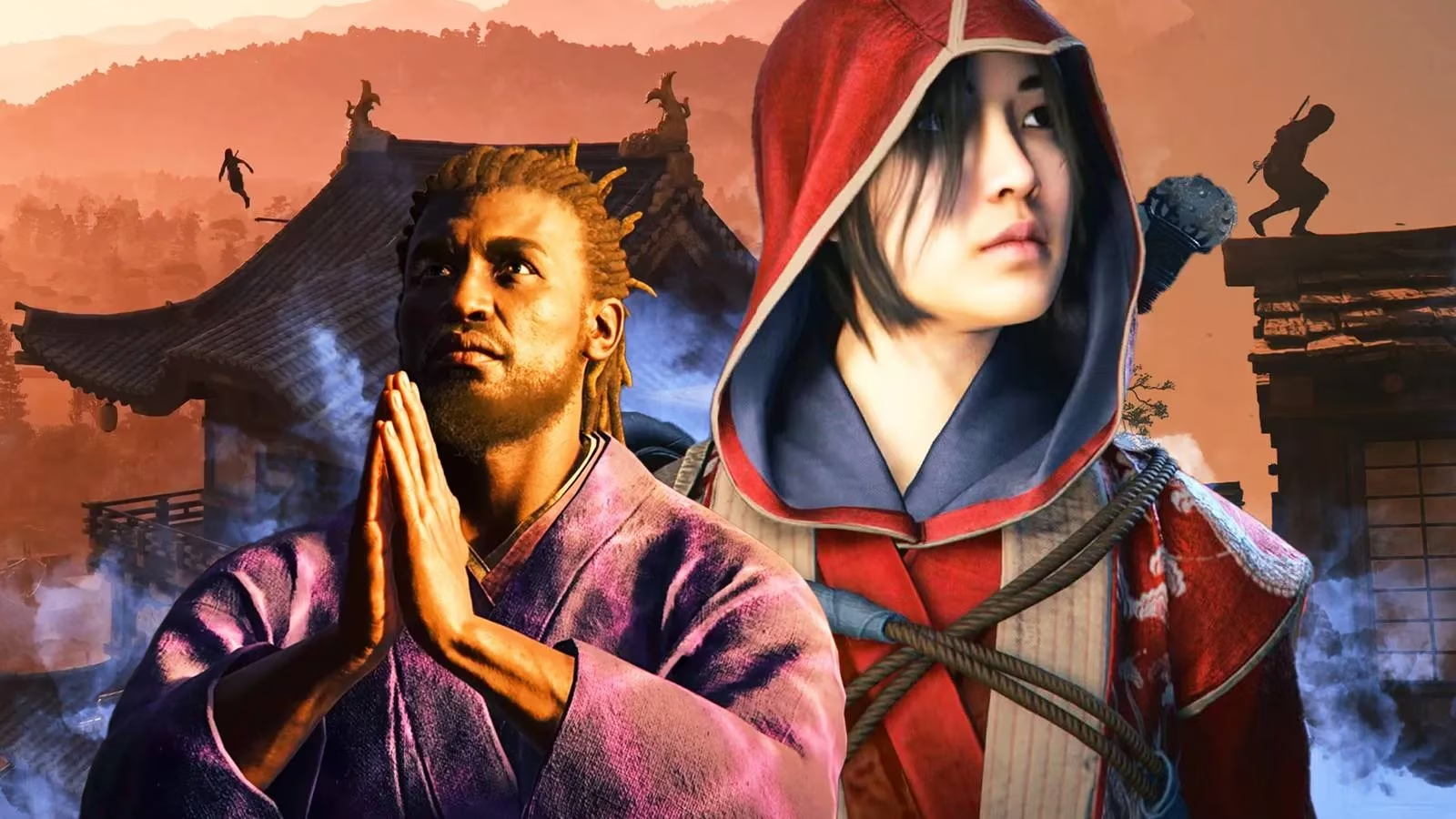
Three new mechanics form the core of this renaissance, arriving with the late spring update. They are tools of defiance against predetermined paths:
-
Height-Gaining Back Eject: A powerful push backwards and upwards off a wall, reclaiming the verticality that had been lost.
-
Height-Gaining Side Eject: A lateral leap from a clinging perch to a higher ledge, offering escape and new angles of approach.
-
Vertical Ledge Jump: A swift, almost instinctual hoist onto low-hanging ledges, eliminating the frustrating search for alternate routes.
On the surface, these may seem like minor technical adjustments. Yet, in the hands of a player, they are seeds of chaos and creativity. For years, the franchise's parkour has trended towards a comforting, yet confining, automation. A single button held, a path pre-ordained. This new toolkit shatters that linearity. The ejects, in particular, are acts of rebellion—methods to violently and gracefully depart from the game's intended route. Imagine cornered, an enemy patrol closing in. With a back eject, Naoe can launch herself skyward, using two close walls to perform a series of rapid, Mario 64-style wall jumps, vanishing into the rafters as blades swipe at empty air. The side eject transforms a vulnerable hanging position into a moment of opportunity, allowing a quick shift to a flanking perch above an unsuspecting guard.
The monotony of the rope is also being addressed. The grappling hook, while necessary for the vast landscapes and towering castles, often reduced climbing to a bland, automated ascension. The new vertical ledge jump seeks to reclaim the immediacy of touch. Where before one would dangle, slowly reeling upwards and exposed, now a swift jump can instantly secure a new foothold. It is about rhythm, about flow—about turning a climb from a chore into a choreography of conquest.
However, even with these elegant strides, a ghost lingers in the memory—a phantom of perfect motion from an era bathed in Renaissance sun. The updates are a step towards fluidity, but the very world of Shadows presents an inherent challenge. The legendary parkour of the Ezio trilogy was born from its environment: a dense, vertical tapestry of Florentine palazzos and Venetian rooftops, where every journey was an aerial ballet.
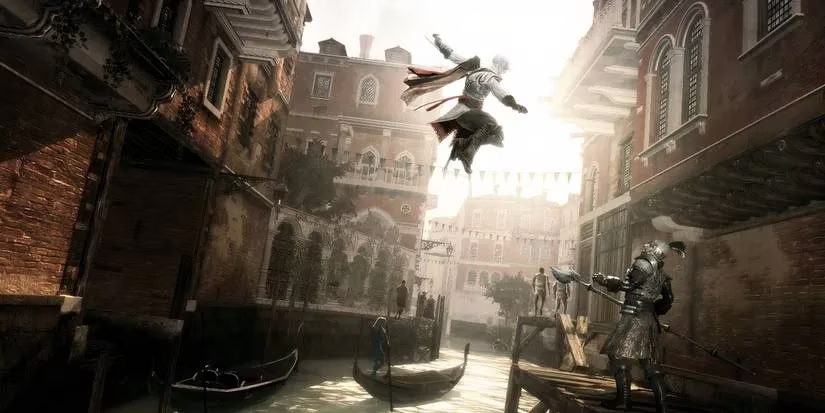
Feudal Japan, in contrast, is a land of sprawling estates, tranquil villages, and vast forests. Its castles—like the imposing tenshu keeps—are islands of verticality in a sea of low, horizontal space. Shadows makes valiant use of what it has, certainly surpassing the near-parkourless fields of Valhalla. One can scale the multi-tiered fortresses, leap between the balconies of a bustling town, or use the grappling hook to swing across cavernous gaps. Yet, these moments feel like brilliant solos in a symphony that often plays in a lower register. Parkour here is sometimes a tool, rather than the very language of the city itself.
The true test of these new mechanics will be how they transform not just moment-to-moment play, but the player's relationship with the world itself. Will the back eject allow for daring new shortcuts across a castle's interior courtyard? Can the side eject enable fluid, continuous runs across the tiled roofs of a merchant district without ever touching the ground? The potential is immense. It promises a return to a core tenet: player agency. The joy of classic Assassin's Creed parkour was in the choosing—the conscious decision to vault this railing, slide under that beam, and leap to a specific window. Automation traded that thoughtful mastery for assured safety, and in doing so, ironically made precise, stealthy movement harder when the prescribed path led directly into an enemy's gaze.
Now, with these tools, players can write their own paths. They can break line-of-sight not by ducking into an alley, but by ejecting vertically out of danger. They can approach a fortified gate not by the obvious road, but by a series of ledge jumps up a seemingly smooth wall. This is the poetry of motion that was promised. The updates are a recognition that parkour is more than a means of travel; it is an expression of character, a silent declaration of freedom against the rigid order of the world. Naoe, the shinobi, moves not just through space, but through the possibilities of space itself.
As 2026 unfolds, Assassin's Creed Shadows is quietly undergoing a metamorphosis. It is reaching back through time, not with nostalgia, but with purpose, to reclaim a feeling of weightless mastery. The new parkour features are the first verses in a new song for the shadows to sing—a song of ascent, of evasion, of breathtaking freedom etched against the rising sun of a digital Japan. The climb continues, but now, every handhold feels like a choice, and every leap, a declaration.