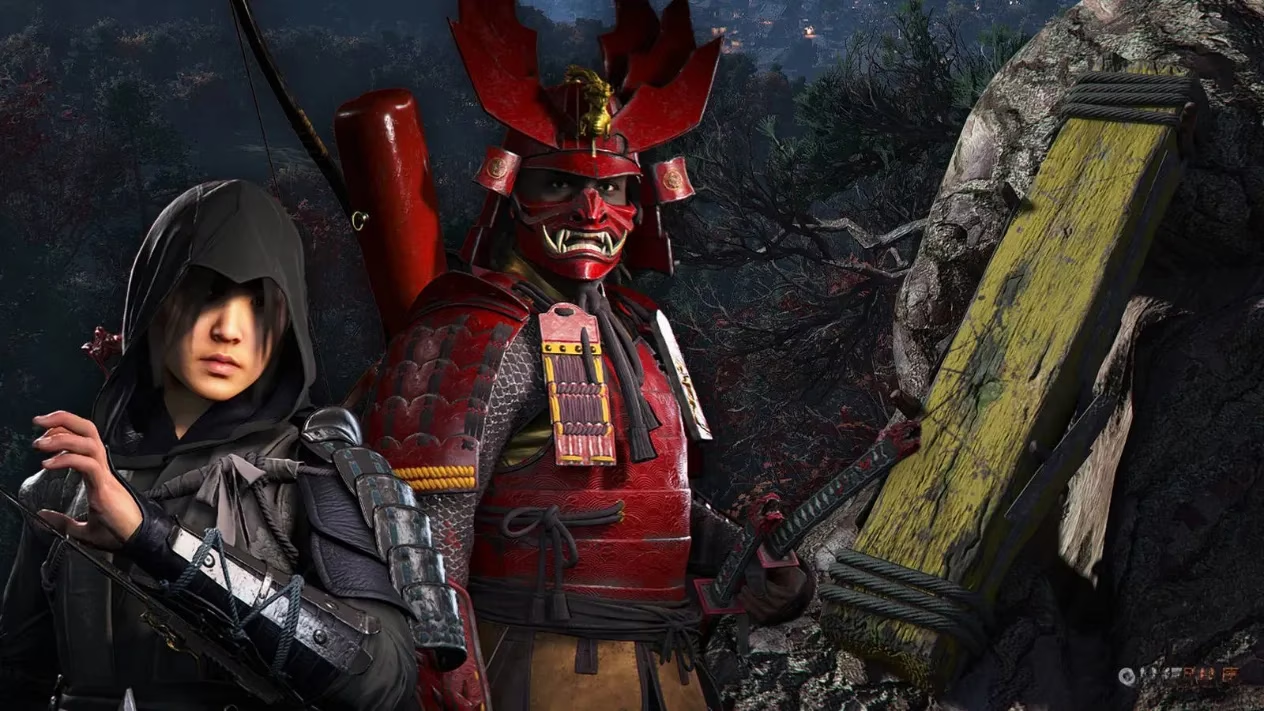
Hey everyone! As a long-time Assassin's Creed fan and someone who's been deep in the world of Assassin's Creed Shadows, I wanted to talk about one of the game's most debated features: the infamous yellow paint. Yeah, I know, it's the thing that's been lighting up forums and comment sections ever since the game dropped. People either hate it for breaking their immersion in this gorgeous, painstakingly recreated feudal Japan, or they grudgingly accept it as a helpful guide. Let me tell you, after spending dozens of hours parkouring across rooftops and sneaking through dense forests, I've come to see this little visual cue in a whole new light. It's not just a lazy design choice slapped on top of the world; it's the result of a really tricky problem the developers had to solve. The controversy is real, but the story behind it is even more fascinating.
The Original Vision: A World Without Guides
Here's the kicker: Ubisoft didn't plan for this at all. Seriously! In an interview, the creative director, Jonathan Dumont, spilled the tea. The initial vision for Assassin's Creed Shadows was a fully immersive, unguided experience. They wanted players to get lost in the authenticity of 16th-century Japan. No bright yellow splashes on climbable surfaces, no glowing outlines—just you and the world. This ambition alone shows how much they prioritized that deep, atmospheric immersion we all crave. They were aiming for a world that felt real and consistent, where finding your path was part of the adventure. 🗾
So... What Went Wrong? Playtest Chaos!
Then came the playtests. And oh boy, did things go sideways. Dumont said players were "really struggling" during the hidden trails activities. Imagine this: you're trying to be a sneaky shinobi like Naoe, following a secret path through a thick bamboo forest or a crowded castle town. The world is incredibly dense and detailed—which is amazing for realism—but it also means everything starts to look the same. Which rock can I climb? Which specific tree branch leads to the next rooftop? Players were getting stuck, frustrated, and it was killing the flow of the game. The parkour, which was designed to be more grounded and weighty, didn't always make it obvious where you could go. This wasn't a case of players being "bad"; it was a fundamental clash between a realistic world and clear gameplay communication.
The Parkour Pivot and World Density
Let's talk about the new parkour mechanics for a sec. Shadows took a more grounded approach compared to the superhuman acrobatics of some past games. This was a deliberate choice to match the characters—Naoe's stealth requires careful positioning, and Yasuke's brute strength isn't about flips. But this realism has a downside: your movement is more limited. You can't just leap onto any surface from a mile away. Combined with the world's insane density (which, again, is historically accurate for feudal Japan's landscapes and settlements), it created a perfect storm. Distinguishing a climbable wall from a decorative one, or a usable ledge from a simple outcrop, became a visual puzzle the game didn't intend to be.
The "Necessary Evil" Solution
Faced with this dilemma, Ubisoft had options, but none were perfect:
-
Option 1: Radically redesign the parkour system to be more forgiving and "sticky." ❌ Problem: This would break the grounded feel and character-specific gameplay they built.
-
Option 2: Simplify and stylize the world geometry, making climbable stuff obviously different. ❌ Problem: This would utterly destroy the visual authenticity and immersion of feudal Japan.
-
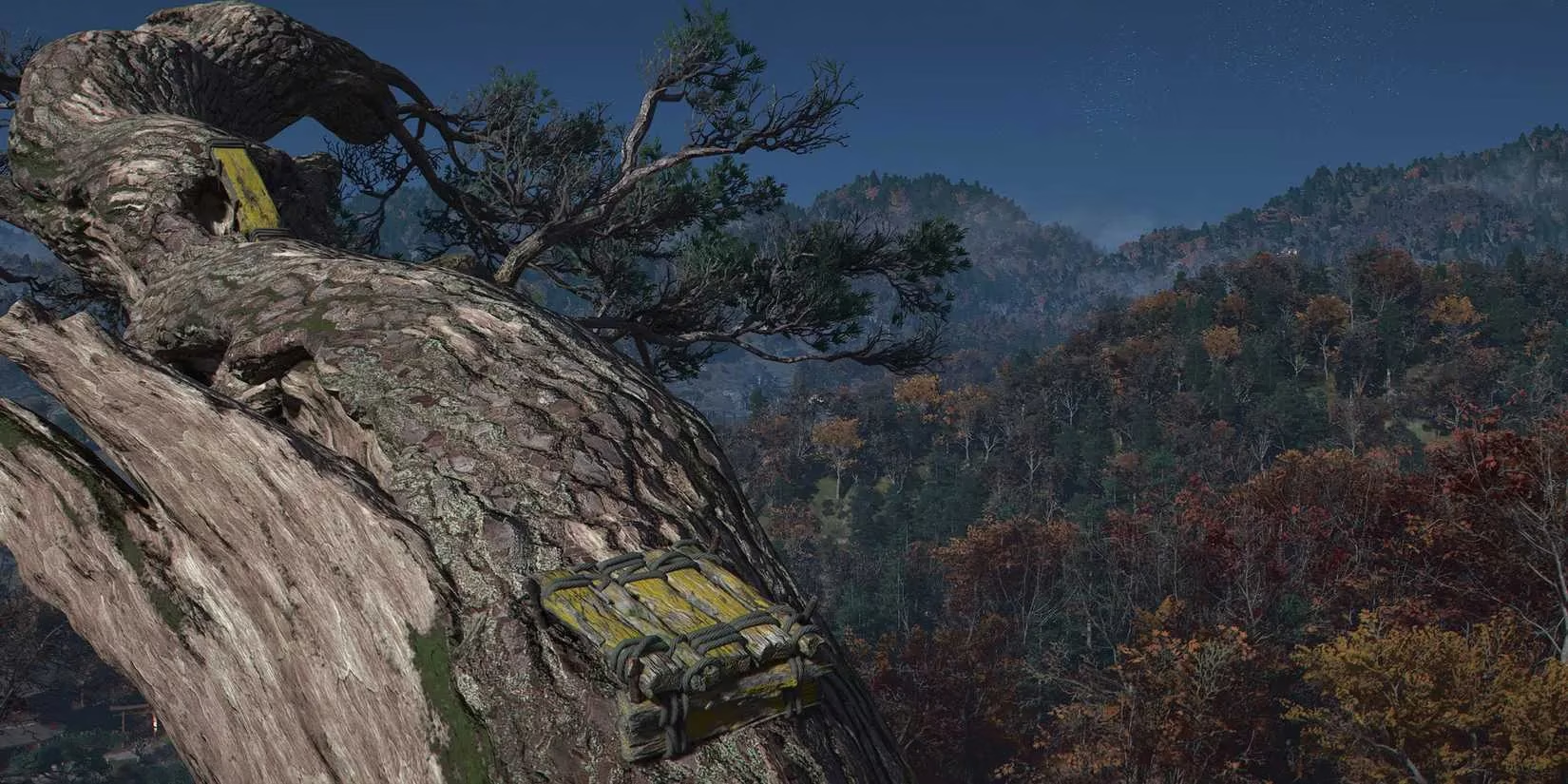
Option 3: Add a subtle, consistent visual signpost. ✅ This is the path they chose.
The yellow paint, or "signposting," became that compromise. It's a band-aid, sure, but it's a surgical one. It directly addresses the confusion players had without altering the core world design or the new physicality of the parkour. Think of it like trail markers in a real-world national park—they don't change the beauty of the forest, but they keep you from getting lost.
Immersion vs. Intuition: Finding the Balance
I get it. Seeing that bright yellow on a centuries-old wooden beam can feel jarring. It screams "VIDEO GAME" in a world that's otherwise whispering ancient secrets. But let's be real—what's more immersion-breaking?
-
A small, consistent visual hint that you learn to subconsciously recognize? Or...
-
Spending 10 minutes running in circles against a wall, mashing the climb button, completely pulling you out of the narrative because the game failed to communicate?
For me, and apparently for the devs after those playtests, option 2 is the bigger sin. The yellow paint ensures exploration stays intuitive. It preserves the player's agency and momentum. You spend less time fighting the environment and more time engaging with the story, the stealth, and the combat.
| Argument Against Yellow Paint | The Defense & Reality in Shadows |
|---|---|
| It's immersion-breaking. | A frustrated player stuck on geometry is far more immersion-breaking. The paint is a consistent, minimal language. |
| It's a lazy design shortcut. | It was a targeted response to a specific, observed problem (playtest struggles). Lazy would have been not trying anything. |
| They should have fixed the parkour/world instead. | Altering those would have compromised the core artistic and gameplay goals (grounded feel, historical density). |
Final Thoughts: A Compromise for the Greater Good
Look, in an ideal world, Assassin's Creed Shadows would have such perfectly telegraphing level design that no guides were needed. But game development is a series of complex trade-offs. Given the constraints of their ambitious vision—a grounded parkour system in a densely packed, historically authentic open world—the yellow paint might genuinely have been the best available path. It's not the most elegant solution, but it's a functional one that serves the player's experience first.
So next time you see that splash of yellow on a shrine roof or a castle wall, don't just see a design flaw. See a developer listening to feedback, see a solution to a real problem, and see a small concession made to protect the much larger achievement: letting us all run, climb, and hide within a breathtaking version of feudal Japan. It's a compromise, but one that makes the game better for everyone, from hardcore stealth masters to newcomers just finding their footing. 🏯✨