When I booted up Assassin\u2019s Creed Shadows in 2024, I had a nagging fear in the back of my mind. I\u2019d been burned before by the promise of two playable heroes in Assassin\u2019s Creed Syndicate. Back then, Jacob and Evie Frye were marketed as two sides of the same coin \u2014 stealth and brawn, subtlety and spectacle. Yet after a handful of hours, I found myself barely switching between them. They felt like interchangeable action figures with different skins and a few exclusive abilities. So, could Ubisoft truly deliver a dual-protagonist system that compelled me to actually use both characters after nearly a decade? The answer, much to my delight, is a resounding yes.
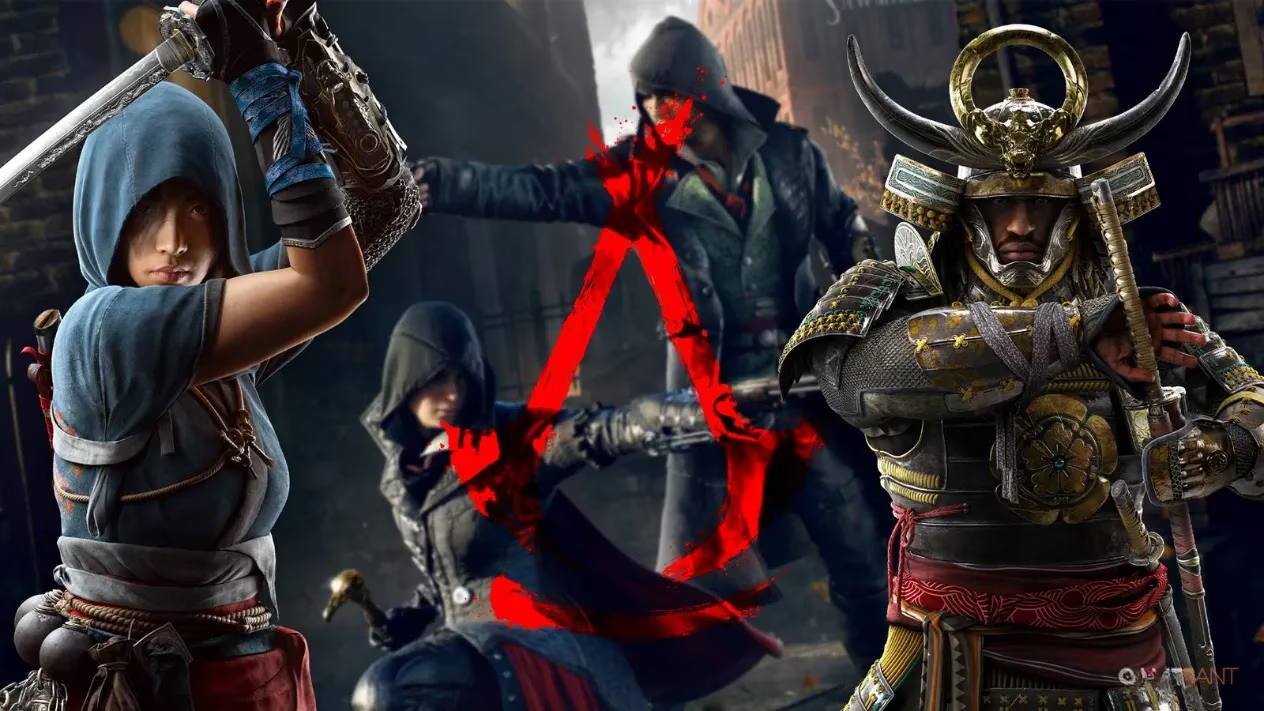
The Frye Twins: A Missed Opportunity
Assassin\u2019s Creed Syndicate gave us the Frye twins in 2015, and on paper, the idea seemed brilliant. Evie Frye would handle ghost-like infiltrations, while Jacob Frye would wade into fistfights and tavern brawls with reckless abandon. In reality, however, the game allowed me to complete almost every mission with my preferred sibling without any real consequence. Sure, Jacob couldn\u2019t turn invisible with Evie\u2019s Chameleon skill, but I could still crouch-walk through most restricted areas with him and assassinate targets from a corner. Their skill trees overlapped so heavily that the choice often boiled down to character personality rather than gameplay necessity. Who did I enjoy listening to more? That became the deciding factor.
Did this ruin Syndicate? No, the game was still a delightful Victorian romp. But it made me question why the dual-protagonist system existed in the first place. If the game didn\u2019t care which twin I used, why should I bother switching? The concept became a novelty, a box to tick on the back of the game\u2019s cover, rather than a meaningful evolution of the formula.
Naoe and Yasuke: Specialization Forced Me to Adapt
Fast forward to 2026, and my playthrough of Assassin\u2019s Creed Shadows is a completely different story. Every time I approached a heavily fortified castle, I instinctively paused at the viewpoint and assessed the situation. Open courtyards filled with samurai patrols? Time to call in Yasuke. A multi-tiered pagoda with dark rafters and bamboo scaffolding? That\u2019s Naoe\u2019s playground. The distinction isn\u2019t just cosmetic \u2014 it\u2019s mechanical to the bone. Naoe is swift, fragile, and virtually silent; Yasuke is a walking arsenal who can kick down doors and shrug off arrows.
Herein lies the crucial design shift that Shadows grasped and Syndicate missed: each protagonist is deliberately deficient in the other\u2019s domain. As Naoe, if I get caught and face three armored guards, I don\u2019t just struggle \u2014 I panic. Her low defense and limited health pool mean a few blows can end her. Running away and re-entering stealth becomes a genuine tactical choice, not a minor inconvenience. With Yasuke, I can stand in the middle of a battlefield and punish anyone foolish enough to approach. But if I try to climb a watchtower and remain unseen? His heavy armor clanks like a dinner bell, and his bulk makes certain parkour routes impossible. He isn\u2019t supposed to be an assassin; he\u2019s a samurai, and the game makes sure I remember that.
How Shadows Atones for Syndicate\u2019s Original Sin
The phrase \u201catoning for sins\u201d gets tossed around loosely, but it fits here. Assassin\u2019s Creed Shadows directly addresses the interchangeable nature of the Frye twins by forcing players to confront the consequences of their character selection. Should I try to assault a fortress exclusively as Yasuke? Yes, and I will cut a bloody path through the front gate, but I\u2019ll also alert every enemy in the compound, lose out on optional \u201cundetected\u201d bonuses, and likely miss the narrative richness tucked into the quiet corners that only Naoe can sneak into. Conversely, a full Naoe run through a mission designed for Yasuke means spending twenty minutes slowly whittling down enemies from the shadows, only to be obliterated if I make one misstep.
This design philosophy does more than differentiate the characters; it fundamentally changes how I view the game world. Locations aren\u2019t just pretty landscapes anymore \u2014 they become puzzles. Is that high window only reachable with Naoe\u2019s grappling hook? Can I eliminate the captain silently before he summons reinforcements? These questions never really mattered in Syndicate because Jacob could do 90% of what Evie could, and vice versa. In Shadows, a wrong character choice transforms a smooth infiltration into a frantic brawl, and I love it. It\u2019s the sort of friction that makes my choices feel weighty.
The Joy of Learning Two Toolkits
Another area where Shadows shines is how it gates player growth. I can\u2019t just invest all my experience points into a single super-soldier. Naoe and Yasuke level up independently, with entirely separate skill trees that reflect their combat philosophies. Naoe unlocks kunai barrages, smoke bombs, and the ability to assassinate from any height. Yasuke gains ground slams, deflection masteries, and the stamina to cleave through three enemies in one swing. Mastering one does nothing for the other. This forced me to genuinely learn two distinct playstyles, which kept even late-game encounters fresh.
Can I play the entire game as just one of them? Technically, yes. But imagine trying to win a naval battle with a rowboat \u2014 it\u2019s possible, but why would you subject yourself to that misery? The increased challenge is real, and the game often whispers, \u201cAre you sure you\u2019re using the right tool for this?\u201d That whisper was absent in Syndicate, and its presence here makes me hopeful for the future of the series.
Looking Ahead: The Future of Dual Protagonists
After spending over sixty hours in feudal Japan, I\u2019m convinced that Assassin\u2019s Creed Shadows has set a new standard. Ubisoft has proven that a dual-protagonist system isn\u2019t just about variety; it\u2019s about reinforcing core themes. Naoe and Yasuke represent two irreconcilable approaches to conflict \u2014 the shadow and the storm \u2014 and the game is better because it refuses to let them blend together.
What\u2019s next? I hope the series continues to experiment, perhaps introducing characters whose differences go beyond combat and stealth. Could a future game feature a diplomat and a warrior, where conversations are as dangerous as sword fights? The template Shadows has laid down is robust enough to support such creativity. Until then, I\u2019ll keep switching between my shinobi and my samurai, grateful that this time, the choice actually matters.